Latest Info on Libya gov spend, Public Purchasing, Govt budget & Public spending
- Home >
- Public Procurement
Public Procurement in Libya
Public procurement in Libya represents a significant channel of public expenditure and economic coordination in an upper middle-income, resource-based economy. Government purchasing plays a critical role in infrastructure rehabilitation, energy-related investments, public services, and institutional operations, particularly in a context shaped by political transition and administrative decentralization.
Public procurement activities are primarily executed by line ministries, public authorities, and state-owned entities. While a unified central purchasing authority is not formally established, procurement functions are regulated through legal instruments issued at the national level.
For suppliers and contractors, government tenders in Libya present opportunities mainly in construction, energy, utilities, transport, and public administration-related contracts.
Country & Economic Overview
| Country | Libya |
| Region | Middle East and North Africa |
| Population | 6,900,000 (2024) |
| Income Level | Upper middle-income economy |
| Base Currency | Libyan Dinar (LYD) |
| GDP | USD 46.5 billion (2024) |
| GNI | USD 48.8 billion (2024) |
| GNI per Capita | USD 9,200 |
Libya’s economy is dominated by hydrocarbons, with public expenditure and procurement strongly influenced by oil revenues and fiscal cycles. As a result, procurement activity fluctuates based on budget execution and public investment priorities.
Institutional Procurement Framework
Libya does not currently operate a single, formally designated Public Procurement Authority or Central Purchasing Body with nationwide coordinating powers.
| Public Procurement Authority | Not formally centralized |
| Central Purchasing Body | Not established |
| Procurement Execution | Line ministries, public entities, state-owned bodies |
| Geographic Coverage | National |
In practice, procurement authority is exercised at the entity level, with ministries and agencies managing their own tendering and contracting processes in accordance with applicable regulations.
Legal & Regulatory Framework
The public procurement legal framework in Libya is governed through executive regulations and administrative decisions, including the issuance of updated procurement regulations in recent years.
The current framework establishes rules for:
- Public tendering and competitive bidding procedures
- Contract award processes
- Administrative oversight and approvals
- Supplier eligibility and documentation requirements
However, several procurement concepts commonly applied in international practice-such as explicit MEAT criteria, life-cycle costing, and standardized value-for-money clauses-are not comprehensively codified within the existing regulations.
Procurement Procedures & Market Characteristics
Public procurement in Libya is largely conducted through entity-specific tender processes.
- Open tenders are commonly used for high-value contracts
- Direct contracting may be applied under specific administrative approvals
- Procurement timelines and thresholds are defined by internal regulations
- Budget availability significantly affects procurement execution
Due to the absence of a centralized procurement statistics system, comprehensive national-level procurement data on volumes and values are not systematically published.
E-Procurement Environment
Libya does not currently operate a unified national eProcurement system.
Most procurement procedures remain paper-based or are managed through internal administrative platforms. Public access to tender information is therefore fragmented and often dependent on individual procuring entities.
Transparency, Oversight & Complaints
Oversight and review mechanisms are primarily administrative rather than judicialized within a specialized procurement review body.
- Complaints are typically handled internally by procuring entities
- Supervisory bodies may intervene in cases of procedural irregularities
- Formal standstill periods and centralized complaint timelines are not uniformly defined
This structure places a strong emphasis on internal controls rather than independent procurement review institutions.
Sustainability & Social Considerations
Sustainability, green public procurement, and social inclusion provisions are not yet systematically embedded within Libya’s public procurement regulations.
- No mandatory green public procurement requirements
- No formal SME or women-owned business set-aside mechanisms
- Limited references to environmental or labor standards in procurement rules
Such considerations may occasionally appear in donor-funded or internationally supported projects but are not standard across national procurement.
Key Challenges & Practical Insights for Bidders
- Fragmented institutional procurement structure
- Limited publicly available procurement data
- Absence of centralized eProcurement infrastructure
- Budget execution uncertainty
Practical bidding tips
- Engage directly with relevant line ministries and public entities
- Monitor official announcements and sector-specific notices
- Ensure compliance with administrative and documentation requirements
- Consider local representation or partnerships where appropriate
Overall, Public Procurement in Libya operates within a decentralized and evolving regulatory environment. While procedural clarity varies across entities, procurement remains a critical mechanism for public investment and service delivery, offering opportunities for well-prepared domestic and international suppliers.
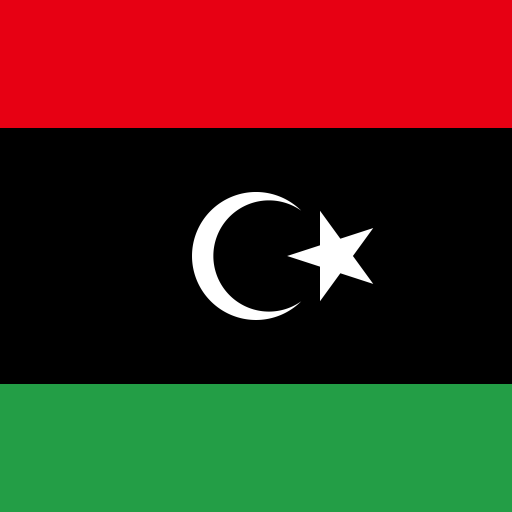
Flag of Libya

Emblem of Libya
Capital
Tripoli
ISO 3166 Code
LY
Population
6,317,000
Area, Sq KM
1,759,540
Currency
Dinar
GDP, Billion USD
674,200
Language
Arabic
GDP Growth Rate, %
-19.8
Inflation, Avg CP, %
-
Interest Rates, %
-
Unemployement Rate, %
-
Exchange Rate, 1 USD Equals
1.36
International dial code
218
Time ZONE
GMT+02:00
Internet TLD
.ly
Get FREE SAMPLE TENDERS from Libya in your email inbox.
Copyright © 2014-2026 LibyaTenders.com. All Rights Reserved.